Indian Ocean-India-Pakistan Conflict and Stability
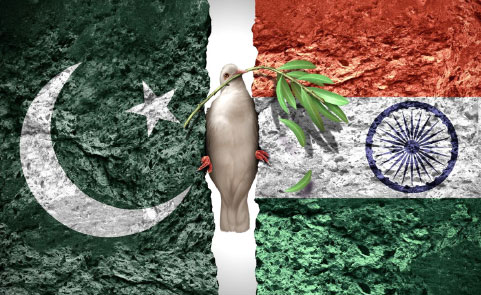
The recent conflict between India and Pakistan kept the region on tenterhooks. The clash between two nuclear-armed neighbours was deeply troubling. Though limited in scale this time, the conflict was uniquely different. It saw emergence and widespread use of electronic warfare tools, precision guided munitions and drone warfare. According to Federation of Nuclear Scientists, each side now has 170 warheads. This stockpile if used could kill millions and render South Asia uninhabitable, perhaps in perpetuity.
What made matters worse was absence of any formal communications channels. This added to the fear of escalation and miscalculation. It was the most serious conflict since the two arch rivals’ demonstrated nuclear capability in May 1998. Had the conflict spiraled, it could have been catastrophic for South Asia as much as Indian Ocean region, home to some 2.9 billion.
As former British colonial states, India and Pakistan have a long history of wars and skirmishes dating back to division of the sub-continent in August 1947. The current crisis erupted following a terror incident in Indian Kashmir on April 22. It left 25 Indian tourists and one Nepalese national dead. In response, India launched a series of strikes on May 7. The targets were allegedly the terrorist infrastructure inside Pakistan. But it was breach of Pakistan’s sovereignty and to an extent fraying of deterrence red lines which had held remarkably well until then. Islamabad responded by taking down at least three Indian air force fighters using Chinese J-10 C, armed with PL 15 E missiles. The following day, India upped the ante. New Delhi deployed drone and loitering munitions reportedly hitting several targets in urban centres of Pakistan including some air defence units. On May 10, Pakistan’s riposte took out some strategic Indian military assets including a battery of S-400 ballistic missile defence system. A tenuous peace prevails for now.
Though a subjective notion, both sides claim victory. India maintains it has established what it calls ‘a new normal’. On its part, Pakistan asserts it has successfully ‘validated conventional deterrence as an effective complement to its robust nuclear arsenal’. While intense land and air combat operations were witnessed for nearly four days, there was eerie calm in Western Indian Ocean. Both navies operated in high state of readiness.
The cost however came otherwise. Foreign shipping companies raised freight charges on all shipments to and from Pakistan. The surcharge was to range between $300 and $800 per unit from Pakistan to US/Africa and from Asia to Pakistan and from Europe to Pakistan. Indian stock markets meanwhile lost an estimated $83 billion in single week once Pakistan launched operation, Bunyaan umm Marsoos, an Arabic phrase translating as, “a structure made of lead”. The fact that United States had to finally intervene to stop the escalating conflict is vivid demonstration of lack political prudence in the region. This should have come with the burden of fielding such capability.
On May 30, addressing crew members’ onboard Indian navy aircraft carrier INS Vikrant, the Indian defence minister stated: “If Pakistan resorts to anything evil or unethical, it will, this time, face the fire power and ire of the Indian navy”. Same day, while talking to Reuters on the sidelines of Shangri-La Dialogue in Singapore, Pakistan’s General Shamshad Mirza, the Chairman Joint Chiefs of Staff Committee, warned about the increasing risk of escalation in future. “You cannot rule out any strategic miscalculation at any time, because when crisis is on, the responses are different”, asserted the Pakistani General.
The importance of Indian Ocean and criticality of the maritime highways that traverse therefrom cannot be overemphasized. The third largest ocean body accounts for over two-thirds of the world’s oil shipments and one-third of world’s bulk cargo traffic. The region is abundantly rich in seabed minerals, precious metals and energy resources. Several nations besides India, Pakistan have huge investments and other stakes in the region. The sea lanes of Indian Ocean are lifeline for economies of South Asia, East Asia and beyond.
As the world’s third largest importer of crude oil consuming roughly 5.3 million b/d (2023), India is enormously dependent on sea lanes for this resource. Over 65 percent of Indian energy goods travel from Gulf to Indian ports. This merchandise drives India’s economic engine. According to Indian Maritime Security Strategy of 2015, over 90 percent by volume and 70 percent by value of India’s trade is transacted via sea. Equally, nearly 98 percent of Pakistan’s trade is seaborne whilst almost entire volume of country’s fossil fuels comes from the Persian Gulf.
Can the two countries risk to adversely affect their own and other economies and thus jeopardize a vital international shipping region eternally? Indian navy can rightfully lay its claims over the region, but its Achilles heel would always be Pakistan navy. Though far smaller, Pakistan navy is a formidable force in its own right. With the backing of China, Pakistan navy has polished its anti-access and area denial strategy. In any future conflict, Pakistan navy can give tough time to Indian navy. But the larger question is –are those in Indian Ocean region and periphery destined to live in instability forever?
In 1946, Bernard Brodie, dubbed as the American Clausewitz and notable for positing basic tenets of nuclear strategy described the beginning of the era of atomic age. “Thus far the chief purpose of our military establishment has been to win wars. From now on its chief purpose must be to avert them. It can have almost no other useful purpose”. Sadly, Brodie’s words sound hollow in Indian Ocean region.
During the cold war, world was clearly divided in two camps. The geographic distance between two global powers provided for if not sufficient, adequate warning time. The Cuban missile crisis set the tone for opening of communication channels and establishing CBMs. It was the prudence of JFK and Khrushchev that brought peaceful end to what perhaps might have been the end of mankind. USSR pulled back from installing missiles in Cuba. Kennedy knew well that it was only the US missiles installed in Turkey (Turkiye) near USSR that triggered the crisis in the first place. He too therefore agreed to remove these as parties reached a secret negotiated settlement.
India and Pakistan have contiguous borders; both are resident states of Indian Ocean. The two have lived in eternal animosity since birth in 1947. When both became declared nuclear weapon states, it was naively thought that region might finally see some stability. This was never to be. The much-anticipated maturity and stability as nuclear weapon states could never develop in South Asia. The strategic instability has instead spilled into Indian Ocean.
The advent of AI driven technologies and precision weapon systems has radically altered the character of warfare. This has caused deterrence to erode at the edges. With both sides making every effort to operationalize the sea leg in nuclear triad, security and economic future of the world hangs in balance. Lastly, it should be a sobering thought that in the absence of diplomatic channels, reciprocal distrust and any state level regulations, the widespread availability of AI technology is an attractive option for exploitation by non-state actors.
Editor Note: The writer is a researcher with abiding interest in geopolitics of Indian Ocean. He has contributed extensively to international magazines and journals.