Solution for Performance Increase and Lifetime Enhancement of Altay Tank Electronic, Electro-Optic Systems and Leopard 2A4
Despite all frequent discussions in recent years, the main battle tanks shall continue their "modern armoured knight" tasks by remaining 40-50 years more in the inventories of the armed forces. Especially the gulf wars and NATO operations being conducted in Afghanistan have proven once more the vitality and prerequisite of such tanks in open terrain. In view of this, many countries have recently been in search of the capacity / capability increase of the tanks taking part in the inventories of their armed forces. For example, the American main battle tanks together with Canadian main battle tanks served in the region during Afghanistan operations occurred short while ago. As per the operations realized in 2006, the main battle tanks were once more evaluated as indispensable under actual conflict conditions and Canada initiated studies to procure newer main battle tanks for its armed forces’ inventory after 2007, though it had previously decided to make reduction in its tank inventory. On the contrary of the expectations, the main battle tank’s field of use has also become prevalent recently. The main battle tanks were initiated to be used at asymmetric conflict environment, which is the major tactical approach of international peace tasks. The operations realized by UN and NATO troops in the Balkan States can be shown as an example on this. In addition, the operations of Western countries in the Middle East are the other example where main battle tanks are used in urban operations.
The modernization of M60 and Leopard 1 tanks taking part in the inventory of our country was successfully realized during the last decade. Participating successfully in both modernization programmes, Aselsan has developed all main Electronic, Electro-Optic and Electro-Mechanical Sub-Systems of Altay tank through the experience gained in such studies and the integration of these systems with Altay tank’s first prototype has been performed. The maximum performance as well as minimum logistic costs and maximum operational availability have been taken as the major design criteria in the development of such sub-systems. The testing of all these sub-systems developed to make Altay’s performance over the rest of the tanks in the world was initiated 1,5 years ago by integrating them on a Leopard 2A4 tank before the integration with the first prototype of Altay tank.
Prototype Leopard 2A4 tank has been tested with firing for 1 year under all seasonal and challenging conditions together with TAF personnel and the results obtained show that the battle performance of such Leopard 2A4 configuration, which has the identical sub-systems of Altay tank, shall be of higher levels. Another critical factor besides performance is that this tank shall be able to use the same training and logistic infrastructure of Altay tank. This approach shall not only reduce significantly the training and logistic costs of TAF, but also increase the efficiency.
Leopard 2A4 tanks, the production of which was launched in 1970’s, have been intensively used in the inventories of especially European countries. They involved superior analogue electronic technology of those times and their performance was more than satisfactory. Even if they met the requirements for a long time, today they fall behind due to their analogue technology with obsolete units and materials and fail to satisfy the changing and new requirements. Thus, at the end of 1990’s, some of Leopard 2A4 tanks were upgraded to Leopard 2A5 level in order to satisfy the changing requirements as well as improve the performance of such tanks. The outstanding aspects of this modernization are putting on thermal image capability to the existing commander’s periscope, reaching at superior performance by using electrical power units instead of hydraulic drivers for routing turret and gun and improving the protection of tank’s front part for tank-to-tank battle environment. Even if the Leopard 2A5 has some new technologies, the electronic and electro-optic systems, which are mainly the same with Leopard 2A4, still fall behind the recent technology. Besides, some other problems are encountered such as the discontinuation of spare parts of at least 30-year-age electronic and electro-optic systems, thus it creates weaknesses in the operational availability of such tanks.
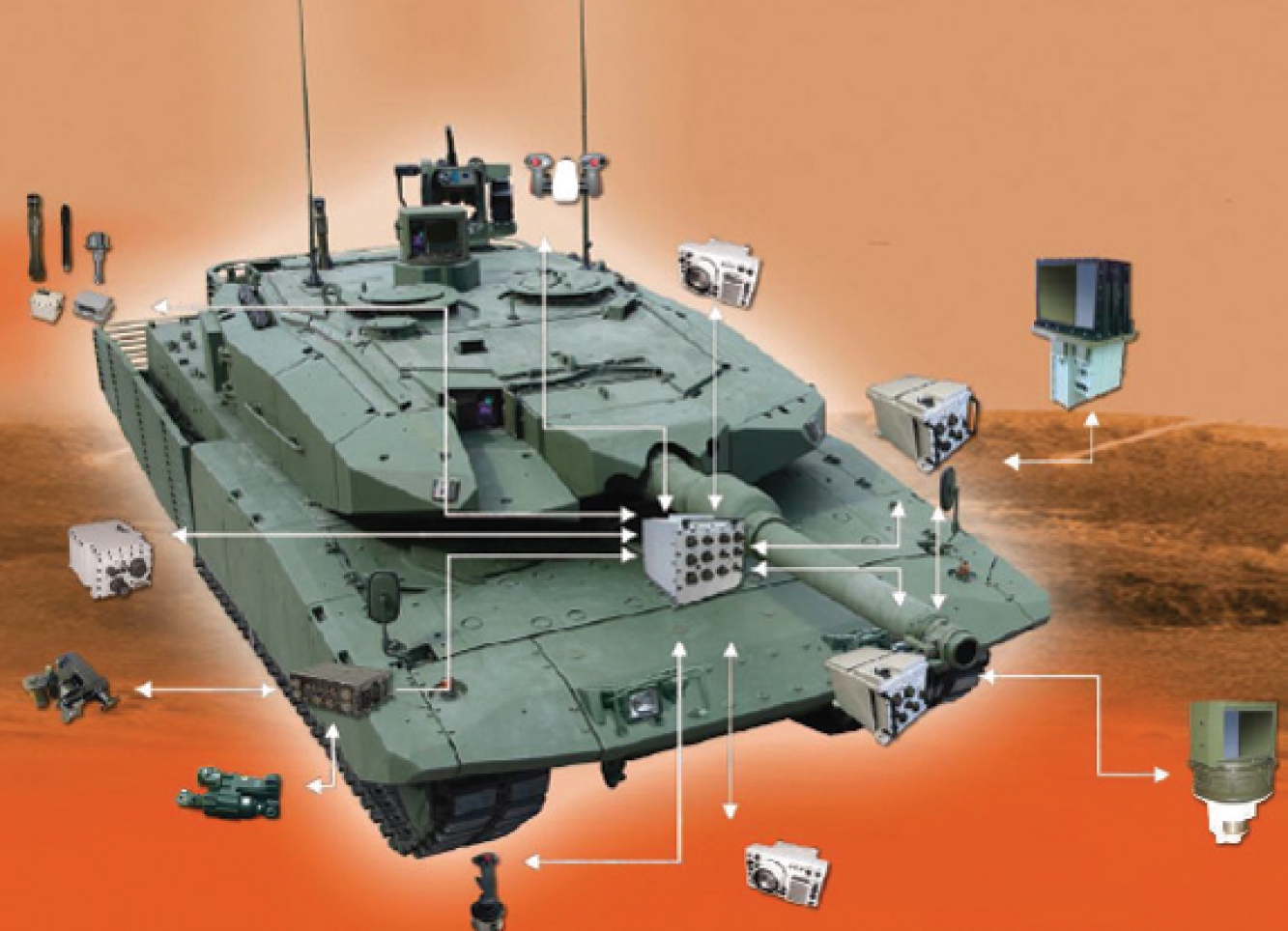
Aselsan has improved the performance of Leopard 2A4 through the systems developed for Altay tank and as a result has provided an exact solution alternative to increasing logistic costs of Leopard 2 user countries. By this "Performance and Life Cycle Improvement Package", not only the life-time maintenance costs of Leopard 2A4 tanks, which are planned to be kept by TAF in the inventory for at least 20 years, would be reduced, but also their performances would be upgraded to 3+ generation. As a result, the acquisitions acquired by Altay project shall be carried further and Leopard 2A4 tanks, which are equipped with the same systems of Altay tanks, would also be a significant force multiplier together with Altay tanks to take part in the inventory in upcoming years.
Leopard 2A4 Performance and Life Cycle Improvement Package
Next Generation Firing Control System comprises of two independent periscopes - one for gunner and the other for commander – and each can perform all tank fire control functions as well as take over each other’s fire control functions. Through the superior image quality, the electro-optical periscopes managed by the gunner and the commander provide both gunner and commander accurate target engagement in day, night and severe weather conditions. In case of a failure in one of the two periscope systems, the tank shall be operational in the battlefield with full performance, a feature that is beyond the capability of the current fire control systems. The fire control functions, ballistic calculations, stabilization algorithms and all other computations are performed by both Gunner’s and Commander’s Periscopes. Apart from the classical fire control systems, it includes Inertial Navigation Sensor to achieve a very high First Shot Hit Probability in Moving Tank / Moving Target scenarios. Based on the extremely accurate automatic target tracking function and target state estimation capability depending on the Inertial Navigation Sensor, this configuration has an extremely high hit probability against rotary wing aircrafts, either using Gunner’s or Commander’s Periscope.
Electrical Gun Turret Drives provide sensitive stabilization and high First Shot Hit Probability to main weapon of the tank by operating in integration with Next Generation Firing Control System. Besides, it improves the survivability of the tank and significantly reduces maintenance and life cycle costs since there is no need for calibration or adjustment.
Tank Command Control & Communication System (TCCCS) provides situational awareness to troop taskforce components as well as helps single-point planning and rapid and sensitive decision making, thus it provides operational flexibility within this context. TCCCS, together with Internal Communication System and Radios taking part in system architecture, enables to gather and exchange rapid, clear and sensitive information regarding the battlefield for all components from troop level to single tank level.
Tank Driver’s Vision System (TDVS) includes front and rear thermal and day cameras and provides the driver superior visibility at day and night and under severe weather conditions.
Remote Controlled Weapon System (RCWS) provides the self-protection of tanks against aerial and ground threats and can be used at urbanized terrain under asymmetric conflict environment at the same time. Based on the requirements, RCWS can be used with 12.7 mm heavy machine gun, 7.62 mm machine gun or 40 mm grenade launcher and it can operate in full integration with Next generation Firing Control System. All the controls can be accomplished by the commander by his own firing control system user interface and in addition, the RCWS can also be controlled by the loader using his own user interface and by RCWS’s own sight optics.
Tank Laser Warning System (TLWS) is the state-of-the art threat warning system to detect, classify, identify and give warning of laser threats (Laser Range Finders, Laser Designators and Laser Beam Riders) aiming on the platform and immediately enable the smoke launcher system to mask the tank by smoke against the hostile forces. TLWS operates in full integration with firing control system and RCWS so that the commander and/or gunner periscopes together with the main/secondary weapon shall automatically slew to the threat direction detected by the TLWS and enable the gunner and/or commander to immediately engage on the hostile.