The Vision for the Use of Unmanned Systems in Future Operational Environments Shaped at the 18th Balkan Countries Chiefs of Defence/General Staff Conference!
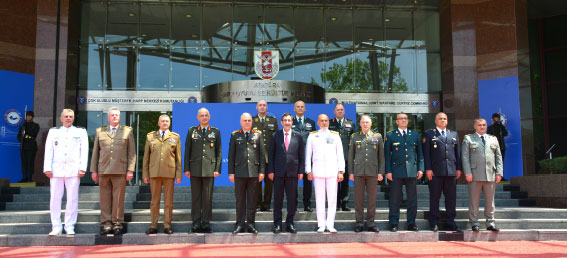
The 18th Balkan Countries' Chiefs of Defense/General Staff (CHODs) conference was held on May 28, 2025, at the Turkish Armed Forces Multinational Joint Warfare Center (MJWC) Command in Levent, İstanbul. Hosted by Türkiye, the conference was attended by the Chiefs of Defense from Türkiye, Albania, Bosnia and Herzegovina, Bulgaria, North Macedonia, Romania, Serbia, and Greece, as well as the representative of the Montenegrin Chief of Defense, the Slovenian Chief of Defense with observer country status, the representative of the Croatian Chief of Defense, and guests including the Chair of the NATO Military Committee, Admiral Giuseppe CAVO DRAGONE, and the Deputy Commander of NATO Joint Force Command Naples, Lieutenant General Peter K. SCOTT.
First held in 2007 under Greece's hosting, the conference was organized in Türkiye for the third time this year, following 2008 and 2016, under the chairmanship of Chief of the General Staff General Metin GÜRAK. Themed "Vision for the Use of Unmanned Systems in Future Operational Environments," the conference was also attended by Türkiye's Vice President Cevdet YILMAZ, who delivered a speech.
The conference, which holds great importance for enhancing relations and cooperation among armed forces, facilitated discussions on how unmanned systems will impact future military operations under the theme "Vision for the Use of Unmanned Systems in Future Operational Environments." Participants were briefed on the NATO Counter-Unmanned Systems Center of Excellence planned to be established by Türkiye. Additionally, presentations were made by Greece on the NATO Maritime Interdiction Operational Training Center and by Bulgaria on the NATO Crisis Management Exercise scheduled for September 2025. The conference also emphasized the commitment to strengthening and developing mutual cooperation among member countries' armed forces, advancing existing military cooperation areas, and creating new collaboration opportunities. The results of the Law of Armed Conflict Course, Special Forces Training, and Computer-Assisted Command Post Exercise hosted by Türkiye were evaluated, and coordination and working group activities conducted in line with decisions from the previous conference were reviewed. The results of courses, training, and exercises held with the participation of member countries' armed forces, along with annual reports, were approved. Evaluations from observer country representatives and NATO guests were received, and tasks planned until the 19th Conference, to be hosted by Greece in 2026, were determined. At the conclusion of the conference, a Joint Declaration emphasizing regional cooperation was signed by member country representatives.
During the Conference, Turkish Defense companies ASFAT, ASELSAN, BMC, HAVELSAN, MKE, OTOKAR, ROKETSAN, STM, and TUSAŞ also set up booths at the Turkish Armed Forces Multinational Joint Warfare Center (MJWC), where the conference was held, to showcase the advanced level of Türkiye's defense and aerospace industry and provide information about their product range. Delegations attending the conference visited these stands during coffee and lunch breaks to learn about Turkish defense and aerospace products. In the afternoon, Chief of the General Staff General Metin GÜRAK, NATO Military Committee Chairman Admiral Giuseppe Cavo Dragone, Balkan Countries Chiefs of Defense, observer country Chiefs of Defense and their representatives, and Deputy Commander of Naples Joint Force Command Lieutenant General Peter K. Scott visited the BAYKAR Özdemir Bayraktar National Technology Center in Başakşehir, Hadımköy, where they received information about the products from BAYKAR Chairman and Chief Technology Officer Selçuk Bayraktar.
Speeches
At the opening of the conference, Chief of the General Staff General Metin GÜRAK expressed great pleasure in hosting the 18th Balkan Countries Chiefs of Defense Conference in İstanbul. Noting that no state or organization can address security threats alone, General GÜRAK emphasized that close cooperation among friendly and allied countries is vital for overcoming these threats.
"The current security environment necessitates strong cooperation and solidarity among neighboring countries. Face-to-face engagements and bilateral or multilateral meetings are among the most effective ways to enhance cooperation in ensuring security and stability. In this security context, our region holds a special place. Since its establishment, the Balkan Countries Chiefs of Defense Conference has been a significant platform supporting stability, cooperation, and good neighborly relations in the Balkans, contributing to the region's transformation into an area of peace and stability. Threats such as terrorism, proxy wars, disruptive technologies, food and energy security, climate change, irregular migration, pandemics, and geoeconomic risks continue to challenge national, regional, and global security. Consequently, the global security environment has become more complex and uncertain than ever before. Simultaneously, with the use of unmanned systems and artificial intelligence, we face increasingly complex, asymmetric, and hybrid threats while security risks diversify and deepen.
In an environment shaped by uncertainty and unpredictability, ensuring national security has become more challenging than ever. Our Armed Forces face significant responsibilities in addressing these risks and threats. As you know, all member capitals have hosted this Conference twice. During this period, numerous important tasks, trainings, and exercises have been conducted within the Conference framework. This year's conference theme has been determined as 'Vision for the Use of Unmanned Systems in Future Operational Environments.' Thanks to visionary steps taken in recent years, Türkiye has become a country frequently recognized for its expertise in this field. We will also have the opportunity to visit BAYKAR, one of the leading companies in this area. Additionally, the Turkish Armed Forces attach great importance to countering unmanned systems. In this regard, we have applied to host the NATO Counter-Unmanned Systems Center of Excellence. We eagerly look forward to sharing our experience in this field with friendly and allied countries and believe we will engage in productive discussions on this important topic."
Speaking at the conference, Vice President Cevdet YILMAZ expressed hope that the evaluations, suggestions, and contributions made during the conference would lead to constructive outcomes serving lasting peace, stability, and prosperity in the Balkan countries. He also expressed his wish for Slovenia and Croatia, participating as observers, to join as full members in the future. Highlighting that the world is on the cusp of a new era driven by rapid advancements in military technologies, Vice President Yılmaz stated that Türkiye is not only meeting its own defense equipment needs with national capabilities but is also capable of addressing the needs of friendly and allied countries.
"The product range of Turkish defense products, exported to 185 countries, has exceeded 230. In the January-April period of 2025, our defense exports reached $2.238 billion, marking a 67% increase compared to the same period last year. Our goal is to exceed $10 billion in exports in the shortest possible time, joining the ranks of countries with double-digit export figures. These figures demonstrate that defense and aerospace are not only about security but are also immensely valuable for a high-value-added economy and elevated social welfare. We will continue our efforts to transfer the competencies we have achieved in the defense industry to civilian sectors, ensuring that these advancements contribute not only to security but also to economic and social prosperity. We are always ready to share our knowledge, experience, and technology with our friends. In this regard, our Armed Forces and Defense Industry are wholeheartedly open to cooperation with Balkan countries. We believe that as we further develop our national defense industry, our contributions to regional and global peace will also grow. As an inseparable part of the Balkans in every aspect, we remain committed to maintaining our constructive, pioneering role that prioritizes engagement with all actors. Türkiye will also continue to uphold its strategic position within NATO."
Press Conference with NATO Military Committee Chairman Admiral Giuseppe CAVO DRAGONE
Following the 18th Balkan Countries Chiefs of Defense Conference, NATO Military Committee Chairman Admiral Giuseppe CAVO DRAGONE addressed the press, providing evaluations and answering questions. Thanking Türkiye for its "extraordinarily impressive organization and hospitality," Admiral Dragone noted that the conference was a great opportunity to bring together all military leaders in the region. He stated that the conference facilitated an exchange of ideas and fostered a shared understanding of the region's security and stability, emphasizing that "NATO's posture is stronger than ever." Dragone highlighted that the conference was dominated by a spirit of contributing to the balance and stability process needed by the region.
Pointing out that the two main threats facing the Alliance are "Russia and terrorism," Dragone stated, "NATO's strategy is to be prepared, and we are enhancing this." He remarked, "Drawing on lessons learned from Ukraine and preparing to adapt to a changing environment and evolving threats in the future, we have decided to improve our overall defense strategy. We must accept that the threat will also change over time." Dragone noted that Türkiye has been striving for peace between Russia and Ukraine from the outset and will be one of the key actors in the peace process. When asked whether NATO's overall defense strategy is shaped by the Russia-Ukraine War, Dragone responded, "NATO is ready for any move by our adversaries."
In his remarks, Dragone also touched on Türkiye's operational capabilities and its significant contributions to NATO missions, particularly in conflict zones, saying, "Türkiye is a strong pillar, a strong reference, and a reliable ally. Türkiye does a great deal for the Alliance. It has the second-largest army in the Alliance. We cannot overlook this. It means something. The readiness and efficiency of the Turkish Armed Forces are undoubtedly at the highest level."
Underlining that Türkiye is a fundamental element of the Alliance's overall strategy, Admiral Dragone noted that Türkiye, which effectively and robustly participates in NATO's Kosovo Force (KFOR), will reassume the KFOR Command in October 2025. Türkiye previously held the KFOR Command from October 2023 to October 2024. Emphasizing Türkiye's importance to NATO, Dragone stated, "You can feel how important, how strong Türkiye is for us, for the Alliance, and how much the Alliance trusts Türkiye. This is a fact. And the KFOR example is just one of many."
In response to a journalist's question about Türkiye's diplomatic efforts to end the Russia-Ukraine War, Dragone said, "Türkiye has done a great deal from the very beginning. Just consider the prisoner exchanges. These were likely made possible thanks to Türkiye. Türkiye hosted meetings, and therefore, its participation and willingness to play a strong role in the peace process are very clear." He added, "To be honest, we are not in a good place regarding negotiations right now. But the point is, we believe Türkiye is at the forefront due to its strategic position, as it is one of the countries right at the edge of the war. We think Türkiye will continue its efforts, and if anything happens, positive results will emerge. Türkiye will be one of the main actors in the peace process."
Addressing a journalist's question about Turkish Unmanned Aerial Vehicles (UAVs) being integrated into the inventories of NATO countries, Dragone stated, "Türkiye was one of the first countries to recognize the importance and growth potential of UAVs." Noting that UAVs have saved many lives, Dragone said, "I don't want to say this is the future, but it will be a critical element to consider for the battlefield." Highlighting the popularity of Turkish UAVs, Dragone remarked, "Yours are at the top. Yours have been proven in combat, and that means something." Pointing out the functional use of unmanned vehicles in air, sea, and land operations, Dragone noted that their use at sea represents a new and critical capability, emphasizing that Unmanned Underwater Vehicles can perform patrol, intervention, and deterrence tasks underwater at low costs





