Water and Fuel – Wherever You Go
Water and fuel are critical to armed forces and emergency services, without both they will not survive. No water means that the soldier or emergency service worker stops functioning and no fuel means that trucks don’t roll and batteries don’t get charged.
WEW of Germany has been providing transportable liquid containers for over 60 years. During this time the company has provided solutions for the chemicals, food stuffs, petro-chemical and defence markets. All of these have one common thread, the need for high integrity solutions which can be transported anywhere in the world whether by sea, road, rail or even by air.
In the defence market the company has built over 2,000 tank containers which are in-service with US, German, British, Belgian, Irish, Slovakian and Latvian forces.
To ensure that armed forces are able to move liquids successfully around the world it is key that the containers are built to at least ISO container standards and have full worldwide certification. These certifications allow the tanks to fully exploit the civil supply chain. Combining this with military hook arm systems, which are also used on some civil trucks and by fire-fighters and natural disaster agencies, a reduced height for stability and deployability, typically with a non-cylindrical, elliptical tank and an internal design which reduces the movement of liquid in the tank gives a solution which allows fuel and water to be delivered wherever it is needed.
These modular solutions, when robustly designed, provide users with water and fuel containers that can be taken into the harshest environments. WEW tanks are deployed into Afghanistan with US, British and German forces.
"We have learnt, fortunately not the hard way, that you cannot cut corners with the design if you want the tank to last more than a few moves," says Dr Ulrich Bernhardt, CEO of WEW. "We have frequently seen cheap tanks on the scrap heap, with the tank broken, after only a dozen deployments by hook arm DROPS or PLS because the design puts the stress on the tank not on the frame."
Once the tank has arrived in an operational area it is still not so easy, there is still much to be taken into account. First of these is how is it to be deployed. As forward operating bases (FOBs) become the more normal method for armed forces to establish a presence in an area and then patrol from there, the FOB needs to have all the logistic support that would be required back in a larger site. Using modular, deployable tanks is an easy way to deliver fuel and water and provide a fuel station or water station inside the base. These tanks require very little ground preparation other than selecting somewhere reasonably flat, have no impact on the environment and can be fitted with all the requirements for pumping fuel or water including generators and water filtration systems so that the water is clean and fit for human use. Just as importantly when the time comes to depart from the FOB the tank can be picked up and taken away leaving no footprint behind.
As the tanks are ‘drop and go’ and require little other support, it is easy to pick them up when re-supply is necessary and replace them with a new one. This ease of movement was part of the design process implemented by WEW and also required that little or no front line maintenance should be needed as those deployed there have little time to do that and need to be focused on carrying out their military or humanitarian task. During the design process the company puts considerable effort into capturing the user’s requirements, finding out how customer want to use the tanks and listening to users’ suggestions as to how any design might be adapted to make deployment and use even easier.
Once a tank is in the overall area of conflict it becomes an asset which requires protection. As with all protection it has to be a balance between level of protection, value of the asset, cost of the protection, weight of the armour and coupled to that the degradation of the tanks capacity – there is only a finite amount of mass that can be moved by DROPS. The basic options available include camouflage – putting wooden boards, for example, on the frame of the tank to hide it; fitting ballistic protection panels, which can add considerable weight; or ballistically protecting the pumps and generators and spraying specialist self-sealing foam such as produced by Hutchinson onto the tank. The choice is for the customer and will depend on the risk he considers the tanks to be subject to.
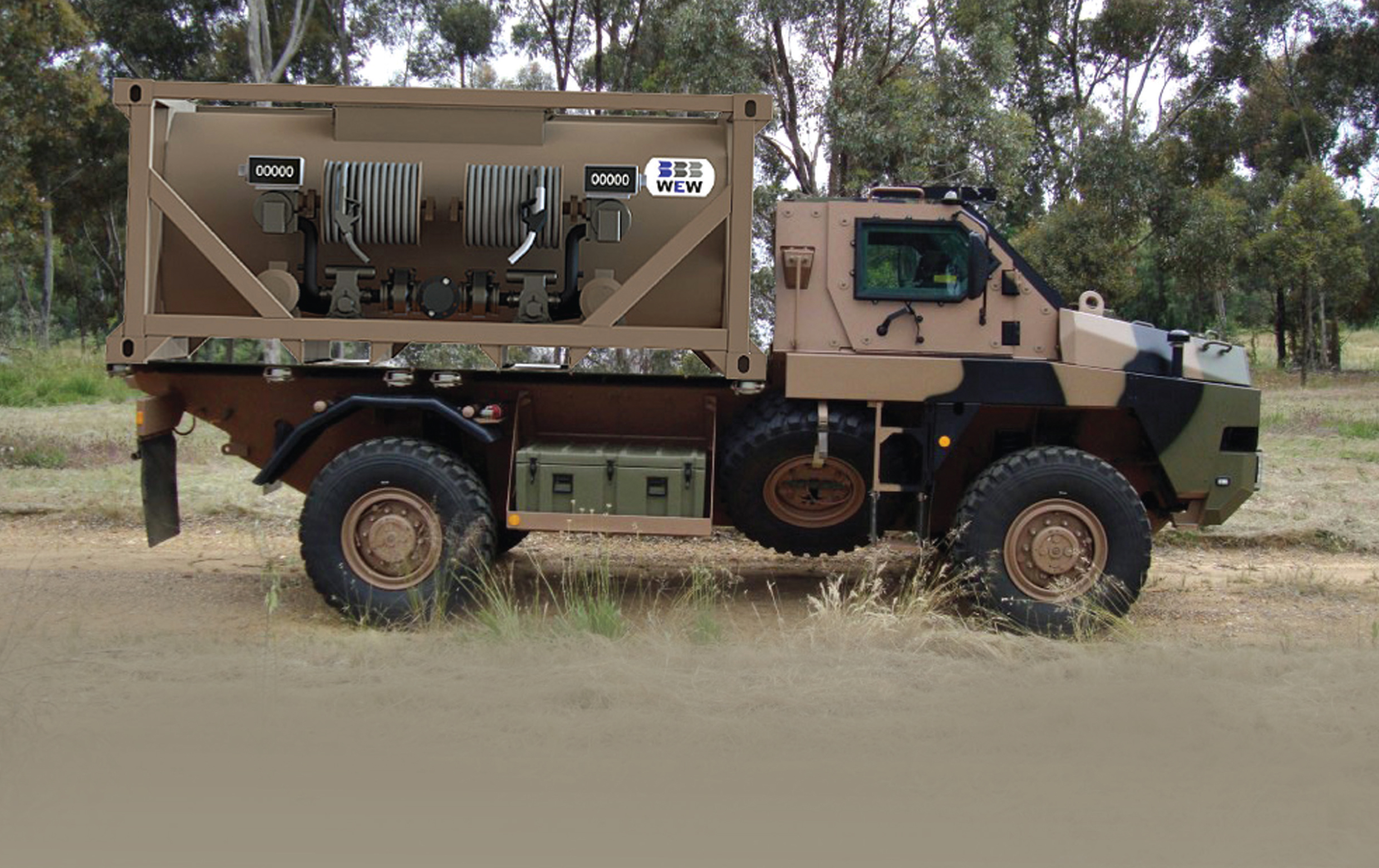
The tanks currently in-service have been designed to be transported on the back of 8x8 vehicles and to carry about 20,000l, going forwards the demand for small modular tanks is growing as the number of Lightweight Protected Vehicles increases across military vehicle fleets. WEW is developing a range of 3000 litre Light Vehicle Modules (LMV) for water and fuel which can be deployed on 4x4 / 6x6 wheeled vehicles such as Hawkei or Bushmaster.
The LMVW (water variant) can be fitted with a cooler /dispenser system which provides the user with temperature-controlled potable water as soon as the unit is deployed.
The fuel variant of this module - LVMF (Light Vehicle Module – Fuel) can be fitted with a variety of pumps, which can deliver from 100L per minute up to 400L per minute of fuel, and has a wide range of protection/environmental options.
Both LMV W and F can also be mounted on a trailer such as the US Army’s ubiquitous M-1095.In the future it is likely that defence forces will be deployed into harsh environments where water is scarce and what is available is dirtier and where fuel to run purification units is in short supply, WEW is looking at using water purification solutions which use less energy such as ultra-filtration. These units destroy bacteria and remove other impurities making the water suitable for both drinking and cooking.
Reducing the size of water and fuel logistic solutions is another area of focus. Of course 100 litres of fuel will always take up a finite volume but the company is looking at how it can pack the heating, chilling and the cleaning functions in a 20’ water tank container rather than needing to have more space for these units.
High mobility forces frequently have a need for multiple fuels for example for their own transport and as a reserve for helicopters working at the limit of their range, so we are looking at how we can develop tanks similar in size to the LMVs capable of carrying two types of fuel securely.